
We Need More Humans Review
A short UFO incremental with a loud joke and a quiet skill tree — who it is for.
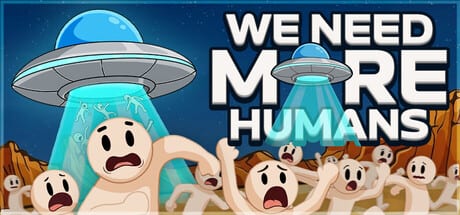
We Need More Humans launched on Steam on 1 September 2026 as a paid single-player incremental from Seafront Games, the one-person Welsh studio behind Scoot. As of 2 September 2026, Steam user reviews sit in Mixed territory (62% of 27 ratings positive). That split is the review. If you like watching numbers explode for two hours, the saucer delivers. If you want meaningful build choices, a campaign, or Destroy All Humans combat, it does not.
This is a buyer’s guide, not a hype sheet. Pair it with getting started if you already own it, and with how to complete for runtime.
The pitch versus the session
The store copy is accurate: abduct everyone on Earth, buy upgrades, take on evolving humans, travel. Crowds really do swell into the tens of thousands. Maps are pretty. The UFO joke lands — French reviewers even compared the class-based payouts to Mars Attacks!. What the copy underplays is how linear the skill tree is. You can see a web of diamonds. You cannot skip a corridor. Several reviewers wanted rival branches that lock each other out. They are not here. Matt Cole has said in replies that the game is heavily inspired by other short incrementals in the same family (players name A Game About Feeding a Black Hole and, behind that, Keep On Mining). If you bounced off those, you will bounce here for the same reason.
What works
- The first 40 minutes. $2 humans, a six-second desert, then snow and a suburb of 5,000 people is a clean ramp. The walkthrough exists because that ramp is the best part.
- Presentation. Hand-crafted isometric towns, a readable population sign, and Evolution gags (ninjas, cows, pigs) that YouTube playthroughs clip for a reason.
- Length honesty. Seafront did not pretend this is a 40-hour live-service. Demo plus full release still sit in the “evening snack” bucket.
- Tech flex. Reviewers who did not love the genre still praised how many moving bodies the game throws on screen.
- Price on the intro sale. A 30% launch discount through 15 September 2026 put it near pocket-money in most regions. Full list is a harder sell for two hours.
What does not work
- Illusory choices. The tree is a checklist. The upgrade priority list is short because the game already picked for you.
- Vague tooltips and silent gizmos. You must experiment to learn that pads and orbs are interactable. We documented them on controls and locations because the game does not.
- Endgame mop. Once population stops climbing, leftover upgrades are expensive and rounds feel slow. That is the Mixed score in one sentence.
- Cosmetic ships without stats. Unlocking a new hull and finding no bonus is a missed hook several reviews mention.
- Pad + tree. Flying is fine. Inspecting locked nodes is not.
- FPS spikes when a fresh swarm spawns on dense maps.
One negative review claimed money wiped every round. The developer replied that it should not, and that the player should be able to grind two maps and buy a bundle of nodes. If you hit a wipe, treat it as a bug, not a design pillar.
Who should buy it
Buy it if you already like short incrementals, you have an evening, and the intro sale is still on. Play Normal, laugh at the evolution tier list, 100% the 19 achievements or do not.
Demo it first if you are genre-curious. The free demo shipped 27 May 2026 and still exists. It is a fair slice of the beam, not a fake trailer island.
Skip it if you need branching builds, narrative, multiplayer, or more than two hours of systems. There is no online play. This wiki will not invent a meta that is not there.
Score-shaped summary (not a number)
As a $5–€7 evening: easy recommend for the audience. As a “deep skill tree” (the press release’s words): oversold. As Seafront’s follow-up to Scoot: smaller, goofier, more disposable, still clearly a solo-dev game with a sense of humour. Future patches could add the missing choices; until then, the roadmap is hope, not a feature list you already paid for.
If you stay, use the early game build so the first hour sings, and the late game build so the last hour does not stall. Official store and socials are on the links hub.
Frequently Asked Questions
Quick answers to the most common questions.
Is We Need More Humans worth it?
At the intro sale, yes if you like short incrementals. At full price, only if two hours of linear upgrades sounds fun. See how to complete for runtime.
Why are Steam reviews Mixed?
People who want choices call the tree fake. People who want numbers going up have a good night. Both are describing the same game.
Is it a clone?
It sits in a family of short incrementals. The developer has acknowledged the inspiration. The UFO joke and isometric towns are the flavour on top.
Should I play the demo?
Yes if you are unsure. It launched 27 May 2026 and teaches the beam without a full-price commitment.
Is there multiplayer?
No. Single-player only. Full controller support and Steam Cloud are the extras.