
Getting Started in We Need More Humans
Your first desert village, first $2 abductees, and the three upgrades that actually matter.
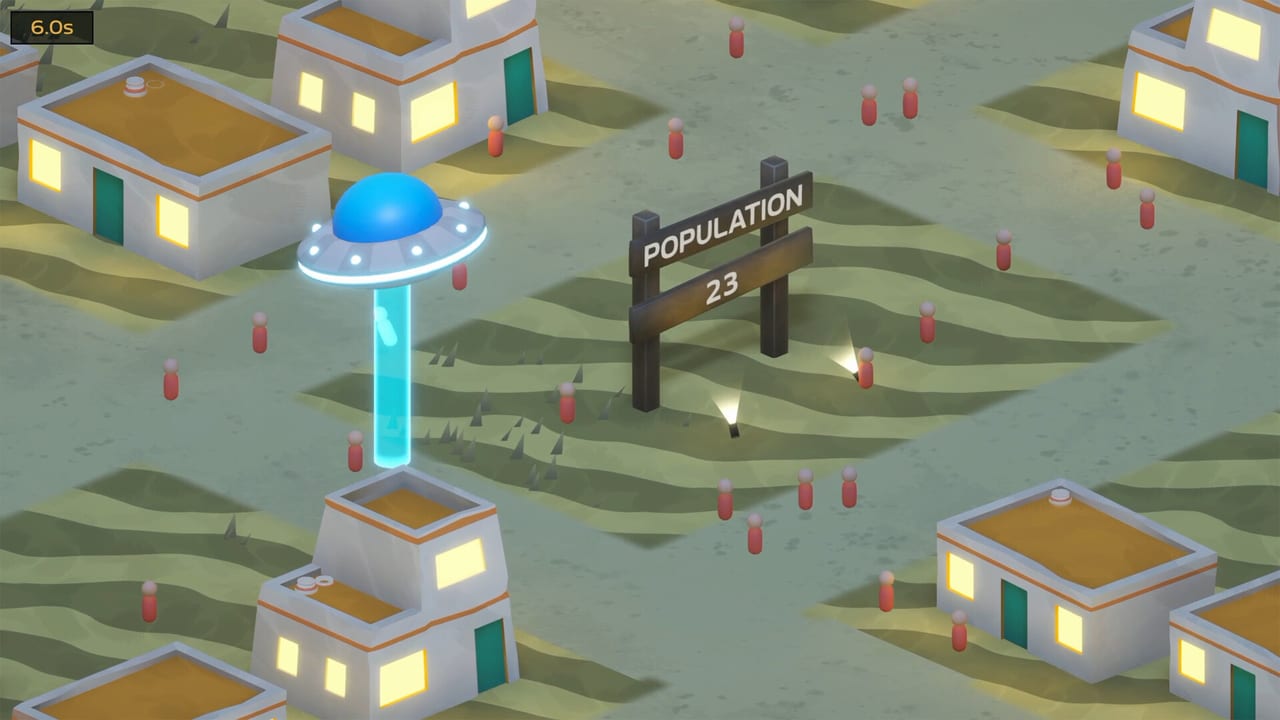
We Need More Humans opens on a quiet isometric settlement, not a tutorial dungeon. A wooden Population sign sits in the sand. Twenty-something stick people wander between blocky houses. A cartoon saucer with a blue dome hovers overhead and a cyan beam hangs under it. Your job for the next two hours is the same sentence: abduct everyone, spend the money, travel to a denser map, repeat. This page is the first-hour version of that sentence.
What you are actually doing
You are not building a base. You are not managing a crew. You fly the UFO across a hand-crafted 3D town, drag a tractor beam over humans, and bank cash when they vanish into the ship. Opening value is $2 per person. Five people is ten dollars. That is enough to buy the first real node on the skill tree — almost always Beam Capacity, the upgrade that used to be labelled Max Abductee in the demo. Radius and abduct strength show up immediately after. Human value is the greedy cousin: it raises what each body is worth so later maps print bigger numbers.
The round is timed. The first desert shot in the Steam gallery shows 6.0s in the corner. That is not a bug. Round Time is itself a tree node; later screenshots show 16.9s, 17.6s, 23.1s. A small + next to the timer is extra time you earned mid-round. When the clock hits zero you cash out, open the tree, and hit Continue. Money is supposed to persist between rounds — the developer said so in a Steam review reply. If your wallet wipes, that is a bug, not a prestige layer.
First five minutes
- Launch from Steam. Pick Normal mode unless you already finished it.
- Move the saucer. You do not need to stop dead on each human. Crossing them is enough; once they are in the beam they tend to stay there while you slide.
- Watch the population sign, not only the floating dollar ticks.
- When the round ends, buy the cheapest unlocked node. Do not save for the $30 million diamonds you can already see on the far side of the tree.
- Repeat until the desert sign hits zero and the game moves you on.
Exact keybinds depend on mouse versus pad; the controls page covers both. Full controller support is on the store page. Steam Deck compatibility is still listed as unknown, so treat handheld as a maybe.
What to buy before you feel clever
The tree is wide and mostly linear. Steam reviewers are right about that. You are not picking a build that locks a rival branch. You are buying the next affordable diamond. Early, that means:
- Beam Capacity so the cone holds more than a handful of people.
- Beam radius so you can graze a street instead of a doorway.
- Human value once capacity is not the bottleneck.
- Evolution the moment it is cheap enough — it changes how humans look and what they pay. The sequence lives on the evolution tier list.
Leave Arm Beam Capacity and the giant hexagonal clusters for later. One Steam screenshot prices Arm Beam Capacity at 15 > 20 for $250.00M while you are sitting on $845M. That is a mid-to-late node, not a starter. The upgrade priority list and early game build spell out the order without making you stare at every icon.
Map objects the game barely explains
Reviews complain that interactive toys are easy to miss. Fly over glowing orbs, crop-circle swirls, pyramid pads, and anything that looks like a gimmick. Some of them spray extra humans, extra time, or extra cash. Late maps add black holes that tug at pickups. None of this is optional flavour on a 14,000-person neon city — if you only vacuum streets, the round timer will beat you. The locations page names the biomes you will see: desert village, snow cabins, packed suburb, dense city, neon night.
How the rest of the wiki plugs in
After two or three maps, switch from this primer to the walkthrough. When the tree becomes a green galaxy, use the skill tree page. When you want the honest length-and-price talk, read the review. Normal mode is a 90–120 minute snack for most Steam reviewers; extra modes and Endless exist after that. The how to complete guide is for the last slow hours when population stops climbing and you are mopping leftovers.
Keep system requirements in mind if you are on a very old laptop: Windows 10, 2.5 GHz, 4 GB RAM, 500 MB for the full game. The May demo asked for 1 GB. Official channels are listed on the links hub.
If you only remember three rules from this page: fly through people, buy cheap nodes, and treat the population sign as the real health bar of the map.
Frequently Asked Questions
Quick answers to the most common questions.
How much is a human worth at the start?
Playthroughs show $2 each on the first village. Human value upgrades raise that quickly.
Should I save money for expensive skill-tree nodes?
No. Buy the cheap unlocked node. The tree is linear; those million-dollar diamonds unlock when you get there. See upgrade priority.
Does the round timer matter this early?
Yes. The desert map starts around six seconds. Buy Round Time when it is cheap, and grab the + extra-time pickups. Details are on controls.
Is there a tutorial?
Not a long one. This page plus getting started and the first desert map *are* the tutorial.
When do I leave the first town?
When the population sign hits zero and the game shows a location-cleared state. Then the walkthrough takes over.